You Post Seven Days a Week and Still Get Called Lazy
By Ash · 5 October 2026
You post every day. You batch content on Sunday nights. You wrote this week's captions in a car park and answered DMs in the queue at the post office. And one in five people scrolling past might be calling you lazy.
That's from Bynder's study of 2,000 consumers across the UK and US. When people read social media copy they suspect was written by AI, 20% said they'd see the brand as lazy. A quarter said impersonal. Another 20% said untrustworthy.
Lazy! The business owner whose last full weekend off predates the logo.
If that stings, it should. You're putting in the hours, and the word coming back is the opposite of everything you've given. So let's work out where "lazy" comes from, because once you can see how it happens, you can change it.
The short version: your audience is wading through more machine-made content than ever, and they've gotten quick at spotting it. When your posts sound like everything else in their feed, they get bored, your posts seem low effort, and you become what every brand fears: forgettable.
Lucky for you, this perception problem is fixable. So, let me show you how the lazy label lands on hardworking brands, why it's so hard to spot from your side, and three checks you can run today.
First, a look at what your customers are scrolling through.
AI slop made the dictionary
In 2025, the Macquarie Dictionary named "AI slop" its Word of the Year. The committee picked it, and the public vote agreed. Macquarie defines it as low-quality content made by generative AI, often full of errors, with almost no editing or human input. Every feed in the country has a sample. The numbers back it up. In February 2026, Sprout Social surveyed 2,250 social media users across Australia, the US and the UK.
- 56% see AI slop on their feeds often or very often.
- 66% are more selective about what they engage with than they were a year ago.
- 50% of Gen Z have blocked, muted or unfollowed a brand or creator because its content felt like AI slop. The farewell takes half a second and one thumb.
AI is allowed in the kitchen
Plot twist: AI copy can win a blind taste test.
In Bynder's study, people read two articles on how to clean a car. ChatGPT wrote one. A trained copywriter wrote the other. Of the people who picked a favourite, 56% preferred the ChatGPT version, but they picked before they knew which was which.
So the robot can write.
The trust issues start when readers can tell.
When people know they're reading AI-generated content, 52% feel less engaged. And 82% said they're fine with brands using AI to help write copy, as long as it feels human-written.
What I'm basically saying here is use AI to help, but sound like yourself when you publish.
When AI content drifts from your brand voice, it starts sounding like the AI that wrote it. So does every other brand whose content has drifted the same way. I call it the Default Voice.
Regardless of you uploading your brand voice guidelines, the Default Voice is the voice every tool reaches for first: polished, agreeable, ambiguous, and available to every competitor with the same subscription.
So why can't you always hear it?
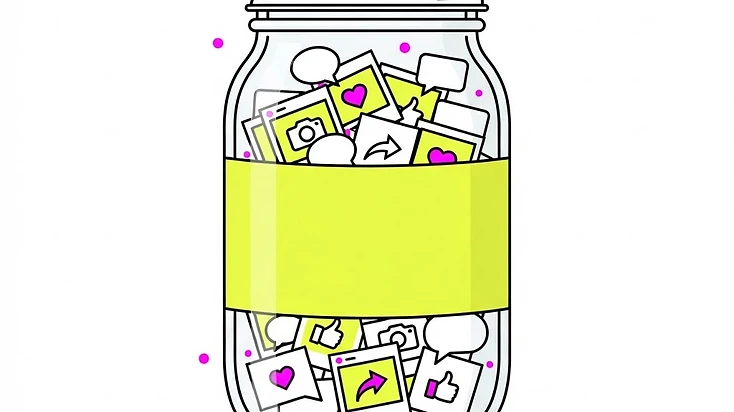
Because you're inside the jar.
There's an old saying in marketing: you can't read the label from inside the jar. The person closest to a brand has the hardest time seeing it the way a stranger does.
Your business is the jar. You're inside it, surrounded by everything you know: the story, the customers, the late nights, the reason every offer exists. Your customers are on the outside. The label is all they get.
You know what every post meant. You know the story behind it, the customer who inspired it and the offer it was setting up. So when you reread a caption, your brain fills every gap with what you already know.
Your customer gets only what's on the screen.
Gaps are normal. Surgeons get second opinions. Writers have editors. Hearing the Default Voice is a skill, and you've spent your years training for a different one: running the business.
AI makes the jar thicker. A content plan from ChatGPT arrives fully formatted, with pillars and posting days. But, whether it suits your customers is a separate question, and the plan sounds equally sure either way.
Even your numbers can fool you from inside the jar
I write brand voice for a living, and I still needed my own numbers side by side to see this.
Most business owners judge content one post at a time. A post does well, so the words worked. A post flops, so the words failed.
I wanted to test how much of that holds up. So I took one short piece of writing and posted it as a Reel four times, months apart, at a similar time of day.
I changed two things: the backgrounds and the captions. All backgrounds were filmed at different locations in nature with the same filter. But some of the captions included a full explanation and some included nothing more than a one-liner that I believed set the vibe.
The words on the reels stayed identical. If the words decided the result, all four versions should have landed in roughly the same place.
| Version | Views | Shares |
|---|---|---|
| A | 5,592,711 | 61K |
| B | 3,408,086 | 31.3K |
| C | 1,247,151 | 3.5K |
| D (trial reel) | 108,513 | 1 |
Same words. Results more than 50 times apart. The best version passed 5.5 million views, while the weakest stopped at 108,513 with a single share (you may have guessed already, but the weakest included a one-liner caption that probably missed the mark).
If version D had been my only post, I'd have decided the writing failed and started rewriting it. The writing was fine all along. The packaging and the explanation changed.
Instagram's insights offer a clue. They list skip rate first among the factors affecting reach, and 58.1% of version D's viewers skipped early, against 38.6% on version B.
People left before the words had a chance.
I'll hazard a guess that they sensed the low effort, without ignoring the fact that other variables in the audience itself may have played a part.
For example, Version C found a different crowd altogether: 92% of its views came from Facebook, and while it still received over 1 million views, their engagement behaviour was much lower.
One flop tells you something changed. Working out what changed takes a diagnosis. From inside the jar, most business owners blame the words, the algorithm or themselves.
Often the culprit is one specific variable you can fix, but you need to be able to view it from outside the jar.
A five-minute jar check
Three tests you can run today with nothing but your phone.
- The name-swap test. Cover your logo and business name, then read your last three posts. Could a competitor publish them unchanged? Make two lists. First, what makes them interchangeable: safe phrases like "elevate" and "seamless" and "it's not this, it's that", the tone everyone in your category shares, claims any business could make. Second, what only you could say: a strong opinion, a real customer story, a detail from how you work, a phrase you'd use out loud. If the first list is longer, you've found the Default Voice.
- The stranger test. Send one post to a friend outside your industry. Ask what you sell and what makes you different. Their answer is what your customers hear. Listen for your point of difference in what they say back. If they describe your whole category, like "you help small businesses with marketing", your posts are selling the category instead of you.
- The one-change test. Line up your three best and three weakest posts. List what differed: hook, visual, audio, format, timing, words. If your winners share a hook style, or your flops share a format, that's your pattern. Next time, change one variable and keep the rest.
When you want fresh eyes on the whole jar
These checks give you a look through the glass. For the whole label, you need someone standing outside the jar.
That's my job.
I audit brand voices and content marketing, so business owners know what's holding their content back and what to fix first.
I review your website, your content and your customer journey myself, line by line. You walk away with a clear read on how far the Default Voice has crept into your brand, a Plain Language diagnosis, and a priority fix list of the changes that will create the greatest impact.
Then we walk through it together on a live call.
You already show up every day. Let's make sure it sounds like you.
References
- Macquarie Dictionary, Word of the Year 2025. Committee's Choice and People's Choice: AI slop.
- Sprout Social, Q1 2026 Pulse Survey press release, 25 March 2026. 2,250 social media users in Australia, the US and the UK, surveyed 5 to 9 February 2026.
- Sprout Social, Stat Library (66% more selective than 12 months ago, Q1 2026 Pulse Survey).
- Bynder, Human Touch survey, 25 March 2024, and press release, 3 April 2024. 1,000 US and 1,000 UK participants.
- Ash Edits Brands, Instagram Reel insights for four versions of the same Reel text, captured October 2026.